Showing posts with label Computers. Show all posts

Friday, June 3, 2011

Technology/Entertainment: Sony Pictures Hack

Sony just can't seem to catch a break. Today marks the first time that Sony has been able to get the PlayStation Network fully up and running since the major hack in April (SOE has been back up since a few weeks ago). It also has significance for Sony in a wholly different way: the Sony Pictures site has been hacked, and the integrity of information for more than one million users has been compromised.

Hacker group LulzSec claims to have successfully hacked SonyPictures.com, managing to gain themselves access to user accounts including passwords, e-mail addresses, full home addresses, and date of birth.

On top of that, Sony Pictures accounts also have a number of opt-in features that contain further information about each user depending on what each signs up for. LulzSec state all of that detail was available to them. They also managed to get the details of all admin accounts for the website.

But unfortunately, the pain for Sony doesn’t seem to stop there, though. 75,000 music codes and 3.5 million music coupons are thought to have been taken. We believe these are codes that allow you to purchase Sony music tracks at a discounted price, or in some cases even for free.

The most shocking and possibly damning thing revealed by this hack is the fact that Sony stored all the Sony Pictures account passwords in plain text. No encryption means no work for the hackers, beyond gaining access to the server.

This is an excerpt from a post by LulsSec on Pastebin.com
Our goal here is not to come across as master hackers, hence what we're about to reveal: SonyPictures.com was owned by a very simple SQL injection, one of the most primitive and common vulnerabilities, as we should all know by now. From a single injection, we accessed EVERYTHING. Why do you put such faith in a company that allows itself to become open to these simple attacks?


What's worse is that every bit of data we took wasn't encrypted. Sony stored over 1,000,000 passwords of its customers in plaintext, which means it's just a matter of taking it. This is disgraceful and insecure: they were asking for it.


This is an embarrassment to Sony; the SQLi link is provided in our file contents, and we invite anyone with the balls to check for themselves that what we say is true.


This is sure to cause yet more upset for Sony in the press and with users. It also means they have millions of codes to mark as unusable on their system asap.

Wednesday, April 20, 2011

Technology: How to Skin a Lion

If you read yesterday's post then you may quite well figure that this might excite me. It might excite you, too.


Do you find yourself thinking that even though you like how Windows 7 functions, but like the soft Apple trademarked sexiness that is Mac OS 10.7 Lion? Well, you're in luck! A user by the name of "hameddanger" over at DeviantArt has made a skin pack to turn Windows 7 into a much sexier Lion.

Before you get all carried away with yourself, you should create a System Restore point, so if for some reason things go awry, you can roll back to where you were before. he theme pack will patch certain system files, so there’s always a chance something could go wrong, but it should work just fine on both 32 and 64-bit Windows 7 systems, although it works best on 32-bit systems.

The Mac OS X Lion Transformation Pack adds the Lion touch to almost every part of Windows 7 from log on screen to Control Panel. It also installs some unique Mac features to the latest version of Windows. This particular theme is neatly packaged as a no-fuss installer. Just download, double-click, and keep clicking next until you reach the end of the process. After you reboot, several new apps will appear in your system tray, each one imparting a bit of the Lion look and feel - including Leftsider to move the maximize/minimize/restore buttons, UberIcon to add the bounce effect to your desktop icons, RocketDock, and Y’s Shadow.

Tuesday, April 19, 2011

Geek Culture: The Making of an Apple Fanboy

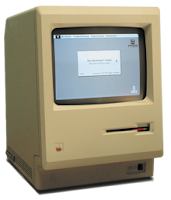
The OG Mac, circa 1984
I wasn't much of an Apple fan growing up. Sure, I got to use the Apple II and the first Mac (pictured at left) and that, in conjunction with the C64 was my introduction to the computer world. At that point, though, personal computing was still a fairly new thing, and we had no idea what we had in store a few years later, so there wasn't anything to hate, either.

Then, years later, I became more and more involved with the media industry, and Macs were the way to go back then. They were work horses, and could handle any task with ease. Oh, and they rarely, if ever crashed.

Fast forward a few years more, and the Windows-based machines had finally caught up, and even surpassed Macs in power and affordability. It became a standpoint that with a Windows machine, you could get twice the power of a Mac, for half the cost. And so, it was back with Windows 98 that I had fully moved into my position as a Windows guy. I had even taken a vehement stance against Apple for some time. But Windows-based computers still had a stigma attached to them that they were unreliable, and if you wanted to do any real work, you would use a Mac. As a studio designer/builder, I encouraged many of my clients to go for a PC instead of Mac, to save them money that they could use for other parts of their studios. This was around the time of Windows XP, and that OS had become very solid and dependable. The more I went around, the more I helped to end that stigma and bring the Windows-based computer up to what is considered a "professional" computer.

I never really cared for the snobbery that came around with your average Mac user. They looked down their nose at anyone who used a Windows computer. They rallied that the only computer you could use for graphics, audio or video applications was a Mac. The media industry as a whole has already proved this not to be true. Avid, a high-end video editing platform company had even made the shift away from Macs. Yes, this was in retaliation to Apple's Final Cut Pro software, and when Apple purchased eMagic's Logic Audio software, Avid's subsidiary Digidesign (the makers of Pro Tools) focused development towards Windows.
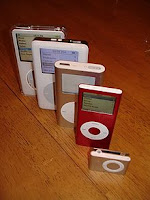
Then came the iPod. And iTunes. Apple finally did what they set out to do with the iMac and iBook a couple of years earlier, and reached the consumer market, lessening their focus on the professional market. Thanks to the MP3 taking over for the compact disc, Apple saw an opportunity that was still virtually untapped and released the first iPod in late 2001. At first, I liked the idea, but the price point was still too high for me to truly develop a proper interest in the product. At this point, mind you, I was still fairly anti-Apple. One of my then favourite bands was setting to release a new album, and the only way to check out any previews was through iTunes. And since I couldn't wait to hear it, I quickly downloaded and installed iTunes and listened to the thirty second clips. Up until then, I listened to my MP3s using Nullsoft's WinAmp, and until then, I thought I had the Bee's Knees of MP3 players. I was wrong. After a little iTunes education from one of my Apple-inclined office mates, I loaded my files into iTunes, and was astonished with how well it was laid out, and how well I could organize my music collection. Around two years later, I finally bought my first iPod (I've since bought two more) and could carry around said music collection in my pocket, instead of having to cart around a pile of CDs along with a bulky portable CD player.

I was pretty happy with my toe dipping into the Apple pool up until that point, then a few years ago, Apple started sticking it to the smartphone market with the awesome iPhone. Even though I was salivating over the iPhone, I had to settle with an iPhone knock-off, once again because the price point was still too high, and I thought the novelty factor would wear off. I was wrong. Again. A few months ago, my work handed me an iPhone 4, and I can assure you, the novelty has not in fact worn off. I have a BlackBerry as my personal cell, but I find myself "forgetting" it at home a lot these days. I also managed to get my hands on an older 1.25 GHz G4. Sure, it's not the latest and greatest, but hey, it was free and free is never a bad thing. And yes, I do happen to use it for my Pro Tools system, but not because Macs are superior to PCs, but because my PC is a laptop, and it's very difficult to stick a PCI card into a laptop.

So coming from an anti-Apple stance, to owning quite a few Apple products, I think I've come a long way. I've fallen in love with the OS X interface, and their newest systems from the Mac Pro, to the MacBook Pro. The Mac Mini is even a pretty neat little system. So, while I am an Apple Fanboy of sorts, I still do have a strong affinity towards PCs, and think it's really all a matter of personal preference, rather than one system being better than the other. But Apple sure does make some really awesome gadgets.

Wednesday, April 13, 2011

Technology: Windows 8 Early Build Leak

Microsoft deciding to release early code to trusted partners is always going to be a double-edged sword. On the one hand, it allows for valuable feedback and bug identification on software before it gets released to consumers and business users alike, on the other, it’s an opportunity for the less scrupulous among us to share that early code with everyone.

Windows 8 is no exception to this rule. A day after screenshots of the Windows App Store leaked, it seems a complete early build of the operating has now been released. The version that has appeared for download is an ISO carrying the name 6.1.7850.0.winmain_win8m1.100922-1508_x86fre_client-enterprise_en-us. It’s a 2.45GB download suggesting this is a full OS release, although it's suspect that much of the code will be Windows 7 with features from 8 being used on top of that base. The screenshots that have appeared backup that suspicion with the system information identifying it as Windows 7 Enterprise.

A leaked series of Windows 8 presentations offers insight not just into what Microsoft wants to accomplish with Windows 8 but also how it plans to go about developing the next Windows.
The company appears to be following much the same blueprint it did with Windows 7 - talking early with computer makers but saying next to nothing publicly until the company is sure what it will be able to deliver. Of course, the leaked documents have thrown a bit of a wrench in that plan.

Shhh.. Let's not leak our hard work!
I doubt Microsoft will be too concerned about this leak as the version is not really Windows 8. It’s Windows 7 in transition and probably has a lot of broken elements. I would also be surprised if there isn’t some security checking in there blocking important updates or eventually turning off functionality.

Microsoft did a great job of sharing Windows 7 in the run up to its release. I am hoping it does the same with Windows 8. That way these leaked builds become pointless as an official preview version is available instead. Microsoft also benefits from their use as it helps identify problems and get them fixed pre-launch.

I figure that Microsoft had every intent for this to get out, much in the same way that they did with Windows Vista. You may remember some years ago hearing about Longhorn. Well, this is essentially what became Vista, which was notably different from the final release. Windows 8 will likely be the same way, since it still seems fairly early in Window 7's lifespan to be hyping a new version of their OS.

Tuesday, April 12, 2011

Technology: Apple Thunderbolt

A Port To End All Ports?

Recently, Apple launched a refresh of their MacBook Pro line of notebooks which feature a new interface port designed to connect the "next generation of high-performance peripherals to the next generation of computers".

Originally codenamed Light Peak, Thunderbolt was initially designed by Intel, and brought to market with technical collaboration from Apple. Using the same connector as Apple's Mini DisplayPort, the Thunderbolt interface combines PCI Express and DisplayPort technologies into a new serial data interface that can run over longer distances with less issue than previous interfaces, such as USB and FireWire. Since PCI Express is widely supported by most device makers, and built into the majority of modern Intel chipsets, Thunderbolt can be added to existing products with relative ease. The Thunderbolt chips fold the data from these two sources (PCIe and DisplayPort) and splits them apart for consumption within compatible devices (nom nom!)

The interface was originally designed to use fiber optic cable (hence the name, Light Peak), but a conventional copper wire version was developed to furnished the desired 10 Gb/s bandwidth at a lower cost. Intel's implementation of the port adapter folds both Thunderbolt and DisplayPort data together, which allows both to be carried over the same cable at the same time. A single port supports both hubs and daisy chain configurations of up to seven Thunderbolt devices, with up to two of these devices being high-resolution displays using the DisplayPort portion of the interface. Adding to the flexibility, Apple and other manufacturers sell DisplayPort adapters for DVI, dual-link DVI,. VGA and HDMI.

Originally conceived as an optical technology, then a combination of both fiber and copper, the final design of Thunderbolt was switched to copper-only connections to reduce costs by providing both data and power via the same cable, thus helping reduce the cost to the end user.

Intel and other industry partners are still trying to develop optical Thunderbolt hardware and cables. These cables will not be able to supply power, but are planned to be able to transport the signal up to 100 meters with conversion between optical and electrical signals to be embedded into the cable itself allowing the current DisplayPort socket to be future compatible.

Apple is touting Thunderbolt as the "fastest, most versatile I/O ever in a notebook", allowing for plug-and-play performance with a new generation of peripherals. According to Apple, Thunderbolt is more than 12 times faster than FireWire 800, and up to 20 times faster than USB 2.0, changing the way you can manage your digital media assets, including the ability to access multiple streams of uncompressed HD video.

Current disk speeds, however, could prevent Thunderbolt from reaching it's full potential of 10 Gb/s. Intel demonstrated throughputs at 62.5% of that peak using prototype products. A fast hard drive system such Promise Pegasus RAID or LaCie's Little Big Disk would bring this even closer to the theoretical peak.

As with any new technology, time will tell how well it will work in the practical world.

Friday, April 8, 2011

Technology: The C64 Makes a Comeback!


The original Commodore 64, circa 1982.
Anyone over a certain age may well remember with a certain fondness the 80s heavyweight, the Commodore 64, the successor of Commodore's then popular VIC-20 (ya, I'm old enough to fondly remember both of those!) followed by the relatively forgettable C128. The C64 made it's public debut at the Consumer Electronics Show in January, 1982, and hit store shelves later that same year. It quickly outsold it's competitors - the Apple II and the Atari 400/800 - due to it's flexible hardware and low cost: an impressive $595US. The C64 managed to out perform business class computers of the day on graphics while remaining relatively affordable. That meant kids got them for Christmas and video games were a favorite on the system. For some it was also the first time they got a taste for programming by entering BASIC code and getting simplistic programs running.

Despite a few attempts by Commodore to discontinue the C64 in favor of other, higher priced machines, constant demand made its discontinuation a hard task. By 1988, Commodore was selling 1.5 million C64s worldwide. Although demand for the C64 dropped off in the US by 1990, it continued to be popular in the UK and other European countries. In the end, economics, not obsolescence, sealed the C64's fate: in March 1994, at CeBIT in Hanover, Germany, Commodore announced that the C64 would be finally discontinued in 1995. Commodore stated that the C64's disk drive was more expensive to manufacture than the C64 itself. Although Commodore had planned to discontinue the C64 by 1995, the company filed for bankruptcy a month later, in April 1994.

Even with it's absence from the market, the Commodore 64 never really fell from public perception. Many musicians took the C64's sound chips and built them into synthesizers, due to it's distinct sound.

The new, and drastically improved C64x.
Fast forward to present day, and the C64 is set to make a comeback, of sorts. In keeping with nostalgia, the new system looks almost exactly the same as the original unit, but the hardware inside is very different and a few decades more powerful. It has also been renamed the C64x.

What Commodore USA has done is fitted a Mini-ITX board inside the casing allowing a modern OS such as Windows or Linux to be run, but also they managed to include a Commodore operating system for that authentic experience.
When you boot the C64x a menu appears allowing a choice between the Commodore OS or your modern OS of choice. Loading Commodore OS 1.0 gives you access to C64 emulation, a classic selection of games, productivity apps, and lots of open source software. It looks like that option may only come later, though, and for now the machine ships with a copy of Ubuntu 10.04.

So how does this new model compare to the original? For pure processing power, graphics performance, and sound capabilities the new C64x easily wins:
C64 (Price: $595 in 1982, the equivalent of $1367 today)
  • 0.985MHz 8-bit MOS Technology 6510 processor
  • 64KB RAM (38KB for BASIC programs)
  • MOS Technology VIC-II graphics chip (16 colors, 112 sprites maximum)
  • MOS Technology SID sound chip
C64x (Price: starting at $595)
  • 1.80GHz Intel Atom processor
  • Up to 4GB RAM
  • Nvidia ION2 graphcis chip (unlimited sprites)
  • Realtek 6-channel HD audio
While the original has ports for a cartridge expansion, composite video, serial bus, tape interface, and a user port for modems, the new model has what you’d expect from a modern machine including a card reader, USB ports, Gigabit Ethernet, DVI, VGA, and HDMI.

How much you pay for a C64x depends on the model you choose, with 5 being on offer (Barebones, Basic, Standard, Deluxe, Ultimate). The options per model include more RAM, a DVD or Blu-ray drive, and larger hard drives. The Barebones unit only gives you the case, chassis, keyboard, and card reader and costs $250. A usable system shoots the price up to $595 for the C64x Basic, and then prices escalate right up to the C64x Ultimate at $895.

A breakdown of the C64x options.

What you are being offered here is a modern machine, but with a retro feel. That’s going to appeal to a lot of original C64 owners, but it may also make for a good way to introduce your kids to the world of computers in the same way you experienced it, only with 2011 levels of performance.

Thursday, April 7, 2011

Technology: Want To Buy a USB Drive In China? Think Again!

Crafty Chinese stores selling 128MB flash drives as 500GB HDD


Every year, the cost of storage medium drops, but the manufacturers keep their price-points the same, by offering up more for the same money. Sounds fair, right? Well, there are a few crafty salesmen out there that have figured out a way to give you less for more.

In China, some clever salesmen have figured out how to create what some would call a magic hard drive. From the outside it looks like an official Samsung portable drive with all the right labels. The salesman will even show you the storage capacity of 500GB and copy a large file to it. What more convincing do you need before a sale at an unbelievably low price? Hand over your money to the smiling salesman, and head on home with your shiny new hard drive.

It seems to accept all your file copies without issue, but when you try to access them, that's when you notice something's gone awry. That HD movie you put on there only plays for 5 minutes before looping back to the start. What the --?! So you wipe the file, and load it again. Same thing.

This is apparently a scenario that's becoming more and more common in certain area of China, particularly close to the Russian boarder. So how does this "magic" hard drive work? A Russian repair shop has figured it out. Soak it in.


Do your eyes deceive you? No, that really is a simple 128 MB flash drive glued to the inside of an external case with some weights inside to make it feel right in your hand. The real clever bit is tricking any computer it connects to over USB into thinking the drive is much larger than it is. A nice bit of programming and modification performed to the controller in the drive, and voila! A 128 MB flash drive that thinks it's a 500 GB hard drive. Talk about delusions of grandeur.

Thursday, March 31, 2011

Geek Culture: Trouble Meeting Girls? Look to the Clouds!


So, you'd like to have a girlfriend, but you're too awkward to go out and meet one? Can't find any women who would understand your comic book and gaming habits (trust me, it's hard to find them, but they are out there)? Afraid of daylight? All you WoWers still living in your parents' basement can take a sigh of relief. If you're the kind of geek who's having some difficulties in the lady department, then look no further than Cloud Girlfriend.

In four easy steps, the nice folks at CloudGirlfriend.com will help you out of this mess:
          Step 1: Define your perfect girlfriend.
          Step 2: We bring her into existence.
          Step 3: Connect and interact with her publicly on your favorite social network
          Step 4: Enjoy a public long distance relationship with your perfect girl.

You'll be the envy of all your Facebook and Twitter friends who will think that you have done the unthinkable and branched out and met someone. But wait! Doesn't Facebook's Terms of Service clearly state that it doesn't allow for the creation of fake people? It does. Some good information is already available on Q&A site Quora, and CGf.com co-founder, David Fuhriman, successfully dodged this question. He noted that other people make up fake personas all the time, and that the created people will in fact be active Facebook users, even if they aren’t real people. Cloud Girlfriends will be real people, not programmed bots, and that there will be no adult services/chat offered. This is simply a ruse to make people (possibly even yourself) think you have a girlfriend.

Don't worry, ladies. Plans are in place to make Cloud Boyfriend happen, if CGf ever gets off the, er, ground.

Friday, March 18, 2011

Geek Culture: Meet the Geek

I'm a geek.  I was born a geek.  I've lived my entire life as a geek.  I will die as a geek.  When I was growing up, the term "geek" was an inflammatory statement, meant to hurt.  Nowadays, it's a way of life, that is widely accepted, and even embraced.  Works for me!

I'm the son of a computer programmer, and for a laugh, I hacked into my father's company's mainframe when I was 13, with an old tank of a laptop (it was smoking fast for the time!).  I've been working with computers since the days of the Commodore64, and the Atari1030xt.  I've been playing video games since the days of ColecoVision and the Atari2600 (the old "wood-grain" model).  I'm also a musician, and so I've been working with Digital Audio Workstations (or DAWs) since I was 15.

I have a degree in Audio Engineering, with a minor on Broadcast Technology.  I was the Canadian support manager for a major international music software company.  I was a technical wireman for over four years, building a variety of television studios in the Greater Toronto Area.  I now work as a radio engineer for a major entertainment company in Canada's largest market.  I have 3 laptops of various degrees of awesomeness, a Mac, two iPods, an iPhone and a Blackberry.  And at my desk at work, I have a Cisco IP phone, and a computer with not one, or two screens, but three.  I also have a display of action figures on a shelf above these three monitors.

And I read comic books, and love superhero movies.